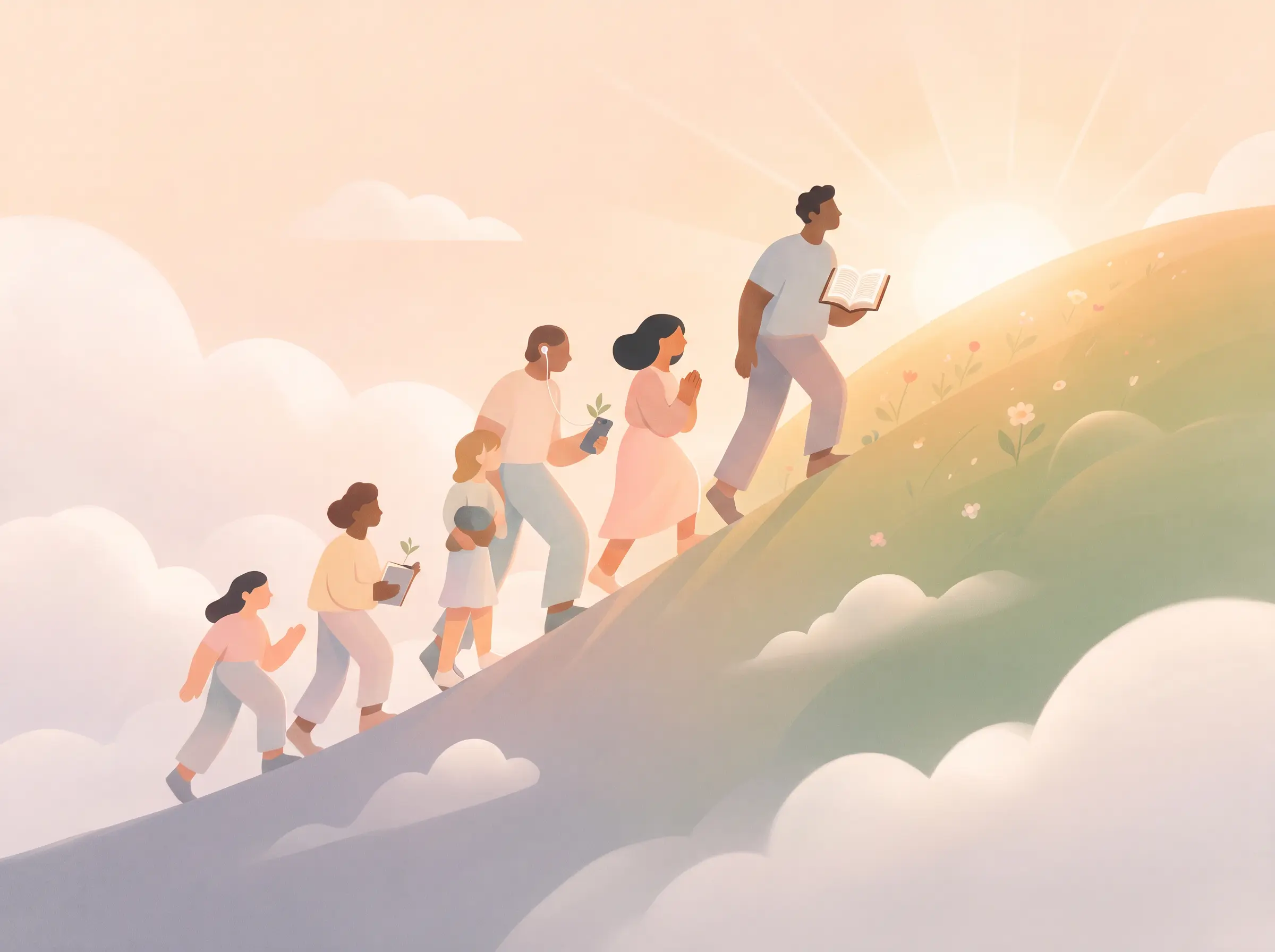
When sin creates distance, many believers automatically default to self-punishment, assuming repentance means proving their sorrow to God through shame. This reaction is rooted in law, not gospel.
We expect the Father to wait for us, arms crossed. But Scripture defies this expectation. In the prodigal's journey, the Father saw his son "a long way off... and he ran" (Luke 15:20).
Repentance is not a trial where we prove our worthiness. It is the transformative act of re-orienting our deepest desires toward the God who is already in motion toward us. It's turning from the pigpen to the embrace.
Teshuvah: Returning Home
The Hebrew word for repentance, teshuvah, literally means “to return.” Not to punish yourself. Not to perform grief. To come home.
In Scripture, sin is described as straying, and repentance is turning back — reorienting your steps toward the God who calls you by name.
Just like the prodigal son walking up the road — tired, ashamed, rehearsing an apology — repentance is a relational movement, not a self-loathing ritual.
And like the father in the parable, God meets us before we finish the walk.
Metanoia: A Changed Mind
The Greek word metanoia adds another dimension: meta (beyond) + nous (mind).
It is a deep shift in understanding — a renewed way of seeing God, yourself, and your life.
When Jesus says, “Repent, for the kingdom of heaven has come near” (Matthew 4:17), He is not asking for dramatic displays of sorrow. He is inviting us to live with a new mind — a mind shaped by truth, grace, and awakened desire.
Repentance is not a one-time apology.
It is:
- seeing God differently
- seeing yourself truthfully
- and letting that clarity shape new choices
Remorse looks backward: “I feel bad.” Repentance looks forward: “I want to live differently.”
What Repentance Is Not
Before we understand repentance, we must clear away what it is not. Many believers confuse repentance with emotional intensity or spiritual performance:
- Not self-hatred
- Not emotional punishment
- Not fear-driven perfectionism
- Not earning forgiveness
- Not performing sorrow to appear sincere
These distortions create pressure but never transformation.
Scripture gives a sobering example in Saul. He often said, “I have sinned,” but nothing in him changed. He wanted relief, not a relationship. Image control, not obedience.
His story warns us: repentance used to manage consequences rather than return to God leads to fear, confusion, and distance.
What Repentance Is
When we combine the Hebrew, the Greek, and the early Christian understanding, repentance becomes beautifully clear.
It is:
- a return to God
- a change of mind and direction
- a reorientation of love and loyalty
- a restoration of the heart
- a Spirit-led transformation
True repentance does not push you down — it draws you in.
It is the movement of the soul back toward the One who heals.
In repentance and rest is your salvation, in quietness and trust is your strength. Isaiah 30:15
Isaiah ties repentance not to striving but to stillness, not to terror but to trust. His words remind us that repentance is stepping back into alignment — returning to the place where God restores, strengthens, and quiets the noise within.
Repentance is not punishment but return. Not shame but renewal. Not self-condemnation but the beginning of restoration.
As you take one small step today, turn your heart toward the Father who welcomes you home, and let Him make you whole again.
References:
Schlink, B., 1984. Repentance: The Joy-Filled Life. Minneapolis, MN: Bethany House Publishers.
GotQuestions.org. What is repentance? Available at: https://www.gotquestions.org/repentance.html
Sedaanbarci. Metanoia: Change Your Life. Available at: https://sedaanbarci.medium.com/metanoia-change-your-life-f70f8df8e73a
Brandeis University, 2021. Atonement and Yom Kippur (Mirsky, J.). Available at: https://www.brandeis.edu/jewish-experience/holidays-religious-traditions/2021/september/atonement-yom-kippur-mirsky.html